Acute appendicitis follows obstruction of the appendiceal lumen, typically by a faecolith or lymphoid hyperplasia, leading to distension, inflammation and, if untreated, perforation.
Clinical presentation
Classically, periumbilical pain that migrates to the right iliac fossa, with anorexia, nausea and low-grade fever. Presentation is often atypical in young children, pregnant women and the elderly. Scores such as Alvarado or AIR help stratify risk.
Radiographic features
Ultrasound
First-line in children and pregnancy. Using graded compression, an inflamed appendix appears as a blind-ending, non-compressible tube more than 6 mm in diameter, with hyperaemia on Doppler and echogenic surrounding fat. An appendicolith casts an acoustic shadow.
CT
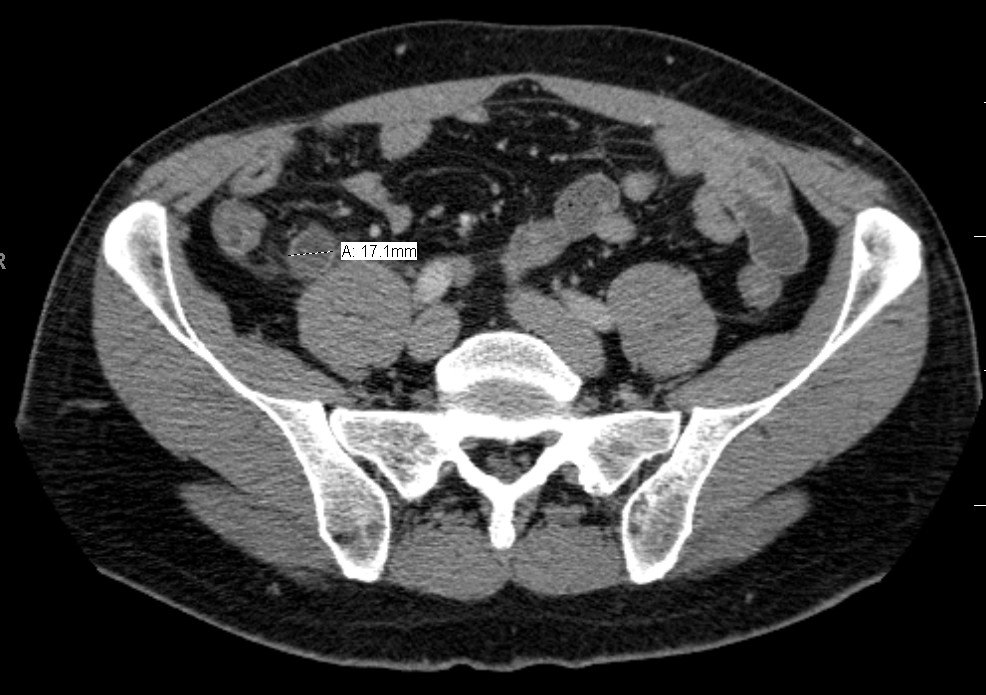
- Dilated appendix (over 6 mm) with wall thickening and enhancement
- Periappendiceal fat stranding
- Appendicolith in many cases
- Complications: abscess, extraluminal gas, phlegmon
MRI
A useful alternative in pregnancy when ultrasound is non-diagnostic.
Treatment and prognosis
Appendicectomy remains standard. Selected uncomplicated cases can be treated with antibiotics alone, accepting a recurrence risk. Perforated appendicitis with abscess may be drained first.
Differential diagnosis
- Mesenteric adenitis
- Terminal ileitis (Crohn's disease, infection)
- Ovarian torsion, ruptured cyst or ectopic pregnancy
- Right ureteric colic
- Epiploic appendagitis
Cases and figures
References
- Di Saverio S, Podda M, De Simone B, et al. Diagnosis and treatment of acute appendicitis: 2020 update of the WSES Jerusalem guidelines. World J Emerg Surg. 2020;15(1):27.
Cite this entry
Acute appendicitis. Radflow Encyclopedia. Last revised 8 November 2026. https://radflow.cc/encyclopedia/acute-appendicitis (accessed 15 November 2026).
Related entries
Educational reference for healthcare professionals and students. It is not medical advice and does not replace clinical judgement or local guidelines.