Croup (laryngotracheobronchitis) is a common viral illness, usually caused by parainfluenza virus, affecting children between about 6 months and 3 years. Subglottic oedema narrows the airway.
Clinical presentation
A barking, seal-like cough, hoarse voice and inspiratory stridor, typically worse at night and following a coryzal prodrome. Severity is judged clinically (for example with the Westley score).
Radiographic features
Croup is a clinical diagnosis and imaging is not routinely needed. It may be used when the diagnosis is uncertain.
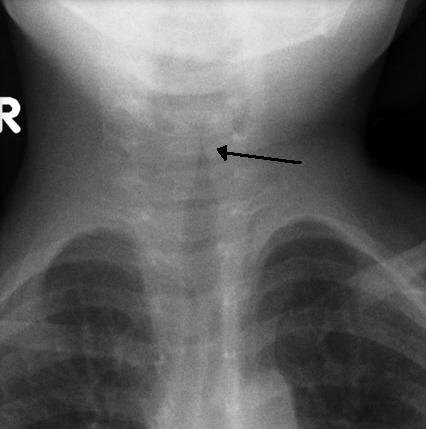
Frontal neck radiograph
- The steeple sign: loss of the normal shouldering of the subglottic airway, giving a tapered, church-steeple shape
Lateral neck radiograph
- Overdistension of the hypopharynx; the epiglottis is normal
Treatment and prognosis
A single dose of oral dexamethasone is effective for all severities. Nebulised adrenaline is used for moderate to severe stridor. Most children recover within a few days.
Differential diagnosis
- Epiglottitis (thumb sign on the lateral view; a toxic, drooling child)
- Bacterial tracheitis
- Inhaled foreign body
- Retropharyngeal abscess
Practical points
Never send a child with suspected epiglottitis or severe stridor for radiographs unaccompanied — keep the child calm and secure the airway first.
Cases and figures
References
- Bjornson CL, Johnson DW. Croup in children. CMAJ. 2013;185(15):1317–1323.
Cite this entry
Croup. Radflow Encyclopedia. Last revised 29 October 2026. https://radflow.cc/encyclopedia/croup (accessed 15 November 2026).
Educational reference for healthcare professionals and students. It is not medical advice and does not replace clinical judgement or local guidelines.